
A Richmond life
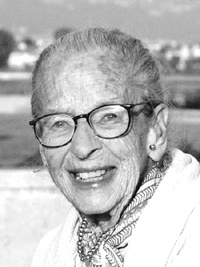
Lucretia W. Edwards was born in Philadelphia on May 15, 1916, and died at home in Richmond on October 12, 2005, at age 89. She came to the Bay Area from the East Coast in 1947, when she married Thomas Edwards, a tugboat pilot. The couple bought a house in Point Richmond with a view of the Bay in 1948, and she lived in it for the rest of her life. Thomas Edwards died in 1995.
Her civic work began in the 1950s with the League of Women Voters. She helped start Richmond’s neighborhood councils, served on city and county commissions, and was one of several founders of North Richmond Neighborhood House in the 1960s. In 1989 she was named Woman of the Year for the 11th Assembly District. She wrote local history too, including Port of Richmond 1901–1980 for the Richmond Area League of Women Voters.
Winning back the shoreline
Edwards said she knew from the day she arrived that it was “ridiculous” that Richmond’s 32 miles of shoreline offered only 67 feet of public access. “I was enraged by what I saw,” she said. “You hardly knew that the Bay was there.”
She led the Contra Costa Shoreline Parks Committee, nicknamed “the little old ladies in tennis shoes,” whose slogans included “Tanks, but no tanks.” Her method, as Tom Butt (now president of Winehaven Trust) later described it: take officials out to the water one at a time and let the place make the argument, with gourmet picnics and cheap champagne. Her campaigns helped create Miller-Knox Regional Shoreline and bring Point Pinole into the East Bay Regional Park District. With Tom Butt she helped save East Brother Light Station from demolition in 1978. In later years she served on the task force that developed plans for reusing Point Molate.
We live in stressful times. Relief from stress of mind, body, and spirit comes from beauty. Lucretia Edwards, quoted on the National Park Service page for Lucretia Edwards Shoreline Park
Winehaven: “great red-brick castles”
Edwards first saw Winehaven in the mid-1970s, when it sat inside the Navy’s Point Molate fuel depot. “I fell in love with the buildings,” she later said. “They are so astonishing, those great red-brick castles. They’re so out of place, it just made me laugh!”
She signed the nomination for the Winehaven Historical Study Committee, which worked alongside the other groups of the Point Molate Task Force. Records were thin: a 1967 fire had destroyed the depot’s administration building, and the winery was barely mentioned in county histories. So the committee interviewed people who had grown up as the children of Winehaven workers, members of the city and county historical societies, and a local newspaperman, and built the nomination from those interviews. The nomination form, signed “Lucretia Edwards, Winehaven Historical Study Committee,” was received by the National Park Service on September 19, 1977. Winehaven was listed as a historic district on October 2, 1978 (NRHP 78000658).
The warning in the nomination
The nomination did more than describe buildings. It explained why the committee wanted federal protection and what it feared. Winehaven had survived, it said, because of “a happy combination of circumstances”: its size, its isolation, and its protective ownership. Then:
But they fear that if the excellent stewardship of the Navy should be terminated Winehaven would be at the mercy of rapacious and exploitive developers and land grabbers. Winehaven nomination, National Register of Historic Places Inventory–Nomination Form, signed by Lucretia Edwards, Winehaven Historical Study Committee
The committee asked that, if the depot were ever declared surplus, “protective mechanisms be built into any transfer of title,” including federal easements on the exterior of the buildings, so that preservation groups could “develop long-term feasibility plans for an appropriate adaptive use.” Nearly fifty years later, the Winehaven Trust is making a version of the same argument: the buildings need an owner who is accountable for keeping the roofs on.
Legacy
In the 1980s, according to Tom Butt’s tribute, she sued the City of Richmond when the Marina Bay master developer and the City proposed moving planned waterfront parks to less prominent sites, and she settled only after the City agreed to preserve the original park sites. One became Lucretia Edwards Shoreline Park, a two-acre park beside the Rosie the Riveter/WWII Home Front National Historical Park visitor center, dedicated in a ceremony in October 2003. Today more than 25 miles of Richmond’s shoreline are part of the San Francisco Bay Trail.
Tom Butt called her the “mother of Richmond’s magnificent 3,000-plus acres of shoreline parks.” The inspiration she left, he wrote, is “an example of how just one tenacious individual can change a city forever.”
Sources
- Tom Butt, “Lucretia Edwards, 1916–2005,” Berkeley Daily Planet, October 18, 2005. berkeleydailyplanet.com. Also reprinted as “The Passing of a Richmond Legend – Lucretia Edwards 1916–2005,” tombutt.com, and in This Point…in Time, Vol. XXIV No. 3 (Nov. 2005), Point Richmond History Association, pointrichmondhistory.org.
- “Lucretia Edwards” (obituary), San Francisco Chronicle, October 18–19, 2005, via Legacy.com. Source of the dates and places of her birth and death, her 1947 move to the Bay Area and marriage to Thomas Edwards, the 1995 death of her husband, and the portrait on this page. legacy.com
- National Park Service, “Lucretia Edwards Shoreline Park,” Rosie the Riveter WWII Home Front National Historical Park. nps.gov
- National Register of Historic Places Inventory–Nomination Form, Winehaven (Point Molate Fuel Department, NSCO), NRHP 78000658. npgallery.nps.gov
- John Geluardi, “Open Space Advocate Honored With a Park,” Berkeley Daily Planet, January 2, 2004. berkeleydailyplanet.com
- City of Richmond, “Lucretia Edwards Shoreline Park.” ci.richmond.ca.us
- California Office of Historic Preservation, “Winehaven,” registered October 2, 1978. ohp.parks.ca.gov
- Historic American Buildings Survey, Winehaven, HABS CA-2658 written historical and descriptive data, Library of Congress. loc.gov
See also: The National Register district · The Point San Pablo peninsula · Winehaven in the press